

We are the institutions
American resistance is rooted in how we do democracy
When Hitler invaded Poland in 1939, students at Smith College were “petrified” that America would eventually fall, too. At that time, world-renowned Polish anthropologist Bronislaw Malinowski was teaching at the college, and he gathered students in his living room and tried to reassure them. He said, “There are things we know in anthropology about cultures…. I don’t believe the United States is going to become a totalitarian nation.” His explanation involved the fact that America has a multiplicity of democratic institutions, not a solid monolithic sense of civic engagement.
(I’m paraphrasing Malinowski here. It’s a game of telephone across decades: He told his students. One of them recounted it at a gathering at Smith fifty-four years later. And I stumbled on her account last year.)
This past week I’ve been thinking long and hard about Malinowski’s view of our country. It reassures me about the future. Right now, we are witnessing two things: How vulnerable our institutions are. And how resilient our institutions are.
And by our “institutions,” I mean us.
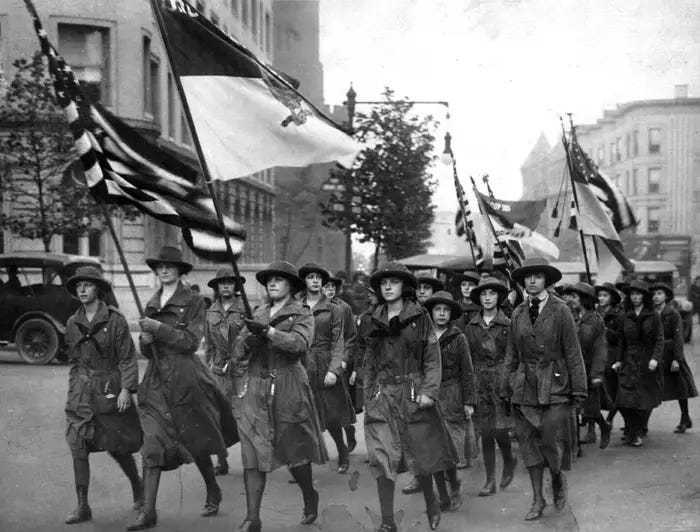
In the United States, we all grow up reciting the Pledge of Allegiance in our public schools. We rise for the Star-Spangled Banner at sporting events. Beyond these common civic demonstrations, we also have particular ways of living out the promise of life, liberty, and pursuit of happiness: Girl Scouts do democratic ideals their way, . So does the 4-H. Also Little League. The BPW and Kiwanis and Rotary participate, and also committees organizing co-op gardens and First Friday art walks. We have the Veterans of Foreign Wars and the League of Women Voters. Across the country, busy professionals volunteer to serve on the boards of organizations founded not for profit but for people. Robert’s Rules of Order gets a lot of exercise in the United States of America.
Embedded in all our civic engagement is a sense of fairness. We agree that we all should be heard. We vote a lot.
Our sense of fairness has been perverted, though. Propaganda has divided us. Culture wars have weaponized values that once united us. Some of us have come to believe that the United States was, all along, solely theirs, founded for the few, when instead it was ours, too, founded for us, all of us. The language of inclusivity and justice has been woven into this country from the beginning: Created equal; inalienable rights; governments…deriving their just powers from the consent of the governed. All along, we’ve been working to enlarge the embrace of “equal,” to expand Constitutional protections to more of us, to live up to the ideals in our founding poetry.
Now, across the political spectrum we’ve been driven into a profound sense of grievance. Feeling aggrieved rarely brings out the best in any of us. We have become tribal. We cheerlead our grievance with the fervor once reserved for Friday night under the lights. We belong to our sense of grievance as we once belonged to our church. Grievance has become our identity, as individuals, but also within political parties, as a country.
Grievance is a perversion of who we are. We have always had profound disagreements. But we also have a Constitution that allows for disagreements – and protects fairness.
The good news is this: Defense of fairness is reasserting itself nationally.
In Maine, more than 400 people signed an open letter asking their county sheriff not to cooperate with federal authorities who are deporting people without due process.
In Wisconsin, people thronged to the courthouse when the FBI arrested a judge for her actions regarding an immigrant appearing in her courtroom.
In the Pentagon, someone is making certain that Americans are aware of gross violations of security protocols by the Secretary of Defense.
From corner to corner, American colleges and universities are banding together against governmental overreach and interference in higher education. More than 520 colleges and universities have signed a letter that concludes: “The price of abridging the defining freedoms of American higher education will be paid by our students and our society.”
This is American resistance.
This is what it looks like when Americans realize nobody is coming to save us but us. We are standing against tyranny with the knowledge that our institutions are really only us, collections of us, deciding what is right, then acting on it.
As Americans, we have learned to get past grievance in our daily civic life, have learned to cooperate with one another around fold-out tables in church basements, to listen to one another around lunchroom tables in school cafeterias. We have protected the minority’s right to have a say. We have voted our conscience. We have learned the value of fairness.
We know how to honor fairness.
Across this nation, in this fraught time, we are remembering that we know how to do this. And we are doing it.